

REVIEW · DISTILLERY TOURS
Toronto Distillery District Walking Tour
The most interesting part of this Toronto walk is the story behind the brick and cobblestones. The Distillery District was not created as a pretty shopping quarter. It grew from milling and grain production into the Gooderham & Worts distillery, once one of the world’s largest whiskey producers, then took on a new life as a place for shops, cafés, restaurants, breweries, and galleries. A good guide makes that change easy to see.
I like the short one-hour format, which gives you useful context without taking over your afternoon. I also like the small group limit of 15, since guides such as Erik, Tom, David, and Zach can keep the walk conversational and point out details you might miss alone. The main drawback is that the tour is brief and mostly outdoors, so bad weather can affect the experience and you will need extra time afterward if you want to shop or eat.
Key points to know before you book

- The story runs from grain milling to Canadian whiskey, giving the district more meaning than its handsome buildings alone provide.
- The one-hour route is easy to fit into a Toronto day, with two regular afternoon departure times.
- Groups are capped at 15 people, a useful limit in narrow historic lanes and busy public spaces.
- Guides bring different strengths, with repeated praise for Erik, Tom, David, Zach, Aaron, and others for clear, lively storytelling.
- The tour returns to 11 Gristmill Lane, so you can continue exploring the district, browse its shops, or find a café nearby.
- The $21.22 price is fair for guided context, especially if you want the architecture and history to make sense rather than simply stroll past it.
Why the Distillery District makes a good walking tour
You can visit the Distillery District on your own. The buildings are attractive, the streets are pleasant to wander, and the area is compact enough to explore without much planning. But without some background, you may see only old brick walls, old industrial windows, and modern businesses occupying them.
The tour gives those details a timeline. You learn how the area began, how its business grew, and how the old industrial site became the modern district you see today. That is the key value here. You are not just looking at preserved architecture. You are learning why it was built, what work took place there, and how the neighborhood changed.
The setting also suits a walking format. The district’s historic buildings and lanes are close together, so you can move from one point to another without spending much time on transfers. The guide can stop often, explain a feature, and keep the history tied to the spot in front of you.
I especially like the way the tour connects local history with the larger story of Toronto. One detail mentioned by a guide is that Lake Ontario once reached much closer to the original windmill than it does today. That sort of fact helps you picture how the city and shoreline have shifted over time.
More Distillery Tours in the world:
- Dublin: Jameson Whiskey Distillery Tour with Tastings
★ 4.7 · 4,859 reviews - Dublin Jameson Distillery Bow St. Tour and Tasting 45 mins
★ 5.0 · 4,690 reviews - Dublin Jameson Distillery and Guinness Storehouse Guided Tour
★ 4.5 · 2,608 reviews
Meeting at 11 Gristmill Lane
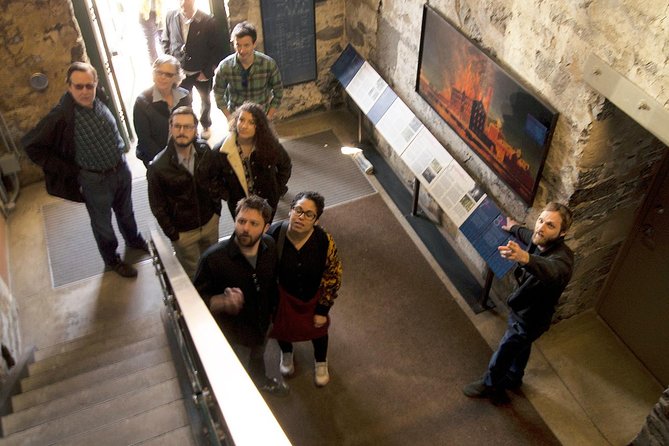
The walk begins at Go Tours Canada on 11 Gristmill Lane, inside the Distillery District. This is both the meeting point and the finishing point, which keeps the plan simple. You do not have to work out a second location at the end or arrange transport back across town.
The meeting point is near public transportation, and confirmation arrives when you book. Since this is a walking activity, arrive ready to stay with the group and pay attention to the surroundings. The area can become active in the afternoon, so giving yourself a little time to find 11 Gristmill Lane is sensible.
The group limit is 15 people. That is not a private tour, but it is small enough for a guide to speak directly to the group and respond to questions. It also matters in a district where a very large group would be awkward around building entrances and narrow pedestrian routes.
The regular schedule offers two afternoon departure times. Other times may be possible by request, but they depend on availability. I would choose the time that leaves you room to stay afterward. The walk ends where it begins, and the district is worth a second look once you understand what you are seeing.
The Victorian industrial buildings tell the real story
The central attraction is the district’s Victorian industrial architecture. The buildings are not simply decorative backdrops. Their scale, materials, and arrangement reflect the work that once took place there.
Your guide explains how the area developed from its foundation to the present day. Expect a mix of outdoor stops and a few indoor stops, with the route centered on the historic district rather than on a single building. The exact order can vary, but the broad story remains the same: production, business growth, decline or change, and later renewal.
This is where guides make the biggest difference. Erik is repeatedly praised for bringing the Gooderham & Worts story to life, mixing facts with humor and local anecdotes. Tom is also described as energetic and clear, while David has a knack for making the past feel practical and easy to picture. Zach and Aaron are noted for being friendly and engaging.
Do not expect a technical tour of every architectural feature. The emphasis is on understanding the place. You will hear enough to notice details you might otherwise pass without seeing, especially the relationship between the industrial buildings and the district’s current shops, cafés, and public spaces.
From windmill and grain to Gooderham & Worts
The historical heart of the walk is the company that grew into Gooderham & Worts. The story begins with milling and grain, then moves toward distilling and whiskey production. That change is important because it explains why this site became such a major business center.
The tour looks at the company’s growth and the business forces around it, including tales of competition and intrigue. You are given a sense of how an operation that started with grain became a huge whiskey producer. That makes the district feel less like a collection of preserved façades and more like a former workplace with an economic purpose.
The title of the story could almost be from flour to alcohol. One especially memorable detail concerns the original windmill and the changing position of Lake Ontario. The city has expanded and altered the shoreline, so the old relationship between the mill and the water is not obvious when you arrive.
If you have an interest in Canadian whiskey, this part will likely be the strongest reason to book. The tour is not described as a tasting experience, so you should not book it expecting a full spirits program. Its focus is the history of production and the district’s transformation.
More Drinks Tours in the world:
- From Porto: Douro Valley w/ Boat Tour, Wine Tasting & Lunch
★ 4.7 · 19,061 reviews - Chichen Itza, Cenote & Valladolid Tour with Tequila and Lunch
★ 4.5 · 15,789 reviews - Complete Douro Valley Wine Tour with Lunch, Wine Tastings and River Cruise
★ 5.0 · 12,920 reviews - Krakow–Zakopane: Cable Car, Chocholow Baths, Cheese & Vodka
★ 5.0 · 10,720 reviews
A modern district built inside an old one
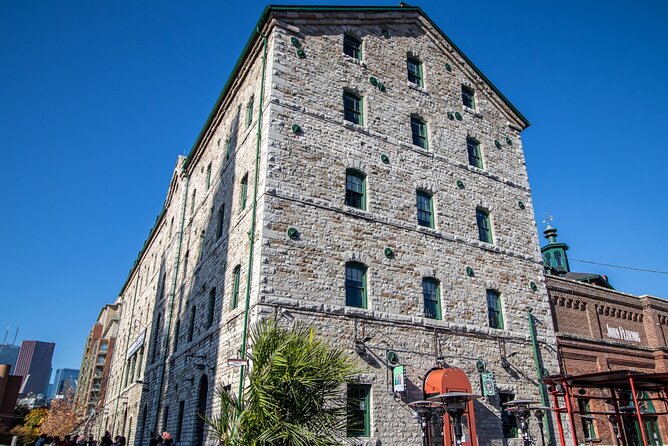
The present-day Distillery District has a different purpose from the industrial site that came before it. The old buildings now hold shops, cafés, restaurants, breweries, and other businesses. The contrast is part of the fun, but it can also make the history easy to overlook.
The guide helps you separate the original function from the current use. You might be standing near a café or boutique, yet hearing about grain, whiskey, workers, and the business decisions that shaped the area. That connection gives you a better sense of why the district feels unusual.
Several guides also point out the area’s modern character. You may hear about the way the site was revitalized and how the preserved architecture now supports a very different kind of activity. The tour does not appear to spend the whole hour discussing present-day shopping, but it gives you enough orientation to explore on your own afterward.
I would leave at least some unscheduled time after the walk. The one-hour route gives you the historical framework, but it does not leave much time for browsing, eating, or lingering. You may find a chocolate stop, cafés, small shops, breweries, and restaurants worth investigating after the guide says goodbye.
The guides make the short format work
A one-hour history walk can go wrong if the guide rushes through dates and names. Here, the strongest part of the experience is the guide’s ability to turn the material into a story.
Erik receives especially warm praise for enthusiasm, humor, and a broad grasp of Toronto and Canadian history. He has also adjusted the walk to conditions, keeping the group in shade or cooler indoor areas on a very hot day. On another occasion, a guide continued with a visitor even though heavy snow left only one person booked.
Tom is described as informative and enthusiastic, with a style that works well for families and couples. David is praised for showing how people lived and worked in the past. Zach has even impressed someone who had lived in Toronto for years, which tells you that the tour can offer something to locals as well as first-time visitors.
You should not assume which guide you will receive. The provider uses several guides, and each will bring a slightly different personality. That is not a major concern here because the repeated strengths are similar: clear explanations, good local knowledge, humor, and genuine interest in the subject.
Families can also make good use of this walk. One guide involved an almost 10-year-old through an activity and connected the stories to the child’s interests. The route is short enough for many children, though the tour remains a history walk rather than a dedicated children’s program.
What the one-hour itinerary feels like
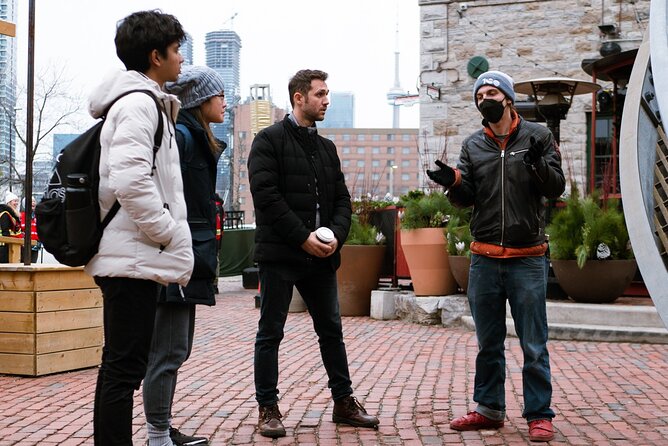
The first stop is the meeting point at Go Tours Canada. It is brief, with no admission charge, and mainly gets the group organized before the main walk begins.
The remaining hour takes place in the Distillery Historic District. You visit several outdoor points and a few indoor locations while following the story from the area’s foundation to its modern role. Since admission is included in the tour price and there is no separate site ticket listed, the cost covers the guide and local taxes rather than an entry-heavy museum program.
The pace should feel manageable for most people who can take part in a standard walking tour. You are moving around a compact district, listening at stops, and then continuing to the next point. Still, this is not a seated presentation. Wear shoes you can walk in, and plan for outdoor conditions.
The route finishes back at the starting point. That is useful because you can immediately revisit a building, stop for food, or continue to another Toronto sight without having to relocate.
Is $21.22 a good value?
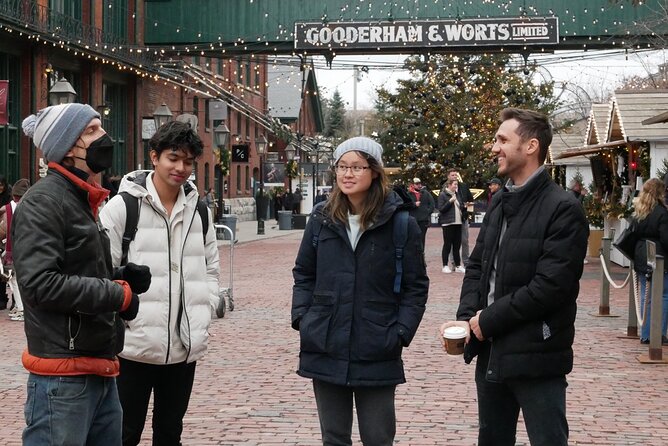
At $21.22 per person, I consider this a sensible purchase if you care about history or want a stronger introduction to the district. You are paying for about an hour with a professional guide, local taxes, and a capped group. The price is not for food, drinks, or a long list of paid admissions.
The value comes from interpretation. You could walk the same lanes for free, but you would not necessarily know that the site developed from milling into major whiskey production, or how the shoreline and city changed around it. A guide also helps you notice architectural details and understand the choices behind the area’s renewal.
The short length keeps the cost and time commitment modest. If you have only one afternoon in Toronto, you can fit this between other activities. If you want an all-day historical experience, it will feel too brief.
For the best value, treat the tour as an introduction rather than a complete visit. Stay in the district afterward. Use the guide’s explanations to decide which shops, cafés, breweries, or buildings deserve more of your time.
Weather, timing, and practical planning
The experience requires good weather. If poor weather causes cancellation, you are offered another date or a full refund. That makes the tour a better choice when your schedule has some flexibility, especially during a season when outdoor conditions can change quickly.
The walk runs twice daily in the afternoon, with other departure times possible on request if space permits. I would book ahead if your Toronto plans are fixed, since the activity is booked an average of 26 days ahead. That does not guarantee that every date fills early, but it is a useful sign that advance planning makes sense.
You can cancel for a full refund up to 24 hours before the start time. Cancellations or changes inside that window are not refunded or accepted. Cutoff times use Toronto’s local time, so check the clock carefully if you are arranging plans from another time zone.
Service animals are allowed, and most people can participate. The information does not describe the route in detail for mobility needs, so contact the provider if you require specific access information before booking.
Who should book this walk?
I would recommend it to first-time visitors who want the Distillery District to make sense, history fans interested in Canadian whiskey, and locals curious about a familiar area. It also suits families with older children who can follow a one-hour story and couples who want a light afternoon activity.
It is a good choice if you like architecture but prefer a guide to explain the practical story behind the buildings. It also works for solo visitors, since the capped group and conversational format give you company without committing to a long day.
I would be less likely to choose it if you want tastings, extensive indoor access, or a full tour of every business in the district. The focus is history, architecture, and urban change. You will need to plan separate time for food, shopping, and any brewery or chocolate stop.
The rating is 4.9 from 327 ratings, with 97 percent recommending the experience. The strongest pattern is clear: guides make the history lively, the route is easy to manage, and the hour passes quickly. That is a solid combination for a short city tour.
Should you book the Toronto Distillery District Walking Tour?
Book it if you want a concise, well-priced introduction to one of Toronto’s most distinctive historic areas. The best reason is not simply that the buildings are handsome. It is that the tour explains how grain milling, whiskey production, changing shorelines, business rivalry, and modern redevelopment all connect.
I would schedule it early in your visit to the district, then stay for cafés, shops, restaurants, breweries, and any indoor stops that catch your eye. If you can choose a guide, Erik, Tom, David, Zach, or Aaron have all been singled out for lively and clear presentation, though assignments are not guaranteed.
Skip it only if you already know the district well and prefer to explore without a guide, or if your schedule cannot handle a weather-dependent outdoor activity. For most visitors, $21.22 and one hour is a reasonable trade for a much clearer understanding of what you are seeing.
FAQ
How long does the Toronto Distillery District Walking Tour last?
The tour lasts approximately one hour, including the walk through the Distillery Historic District.
Where does the tour begin?
The tour begins at Go Tours Canada, 11 Gristmill Lane, Toronto, Ontario M5A 4R2, Canada.
Where does the tour finish?
The activity ends back at the meeting point on 11 Gristmill Lane.
What language is the tour offered in?
The tour is offered in English.
How large is the group?
The activity has a maximum of 15 travelers.
What does the tour include?
The price includes a professional guide and local taxes. The listed tour includes outdoor stops and a few indoor stops in the Distillery Historic District.
Are there regular departure times?
The tour runs twice daily in the afternoon. Other departure times may be available by request, subject to availability.
Can I cancel for a full refund?
Yes. You can cancel at least 24 hours before the start time for a full refund. Cancellations and changes made less than 24 hours before the start time are not accepted or refunded. If poor weather causes the tour to be canceled, you will be offered another date or a full refund.
Just poured in the world
- From Madrid: Toledo Guided Tour & Winery Visit with Tasting★ 4.8 · 313 reviews
- Madrid Region Wineries Guided Tour with Wine Tastings★ 4.9 · 222 reviews
- Ribera del Duero Wineries Guided Tour & Wine Tasting from Madrid★ 5.0 · 328 reviews
- Santorini Sunset Wine Tour with Santo Winery Views★ 5.0 · 342 reviews
- Saint-Emilion Afternoon Wine Tour – 2 Wineries & delicacies★ 5.0 · 614 reviews
- Private Secret Venice Tour; Rialto Market, San Polo & Food and Wine tasting★ 4.0 · 220 reviews
- A Venetian Evening: Wine Tasting and Cicchetti with a Local Guide★ 5.0 · 146 reviews
- Mykonos: Winery Vineyard Experience with Food & Wine Tasting★ 4.9 · 446 reviews
Distillery Tours, compared.

Jameson Whiskey Distillery Tour with Tastings
Read our review →
Dublin Jameson Distillery Bow St. Tour and Tasting 45 mins
Read our review →
Dublin Jameson Distillery and Guinness Storehouse Guided Tour
Read our review →
Nashville to Jack Daniel’s Distillery Bus Tour + Whiskey Tastings
Read our review →
Dublin Teeling Whiskey Distillery Guided Tour and Tasting 1 Hour
Read our review →


Hierve el Agua, Tule Tree, Mitla and Mezcal Distillery Tour
Read our review →Browse the lists this tour appears in